- Tu carrito está vacío
- Continuar comprando


£ 44.40
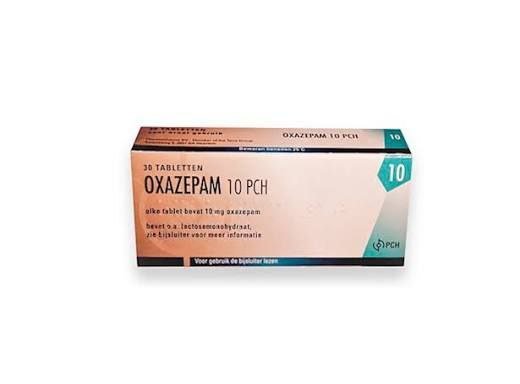
Oxazepam 10 mg is a short-to-intermediate acting benzodiazepine indicated for the short-term management of severe anxiety and alcohol withdrawal symptoms.
Oxazepam is a short-to-intermediate acting benzodiazepine derivative possessing anxiolytic, sedative, muscle relaxant, and anticonvulsant properties. Under the Anatomical Therapeutic Chemical (ATC) classification system, it is indexed under N05BA01.
Chemically designated as 7-chloro-1,3-dihydro-3-hydroxy-5-phenyl-2H-1,4-benzodiazepin-2-one, oxazepam is a 3-hydroxy benzodiazepine. In United Kingdom clinical practice, oxazepam 10 mg is presented as oral tablets. In accordance with the Human Medicines Regulations 2012, oxazepam is classified as a Prescription Only Medicine (POM) and is controlled under Schedule 4 (Part I) of the Misuse of Drugs Regulations 2001 (as amended).
Oxazepam acts as a positive allosteric modulator at the $\text{GABA}_\text{A}$ receptor complex in the central nervous system. It selectively binds to the benzodiazepine site located at the interface between the $\alpha$ y $\gamma_2$ subunits of the ionotropic $\text{GABA}_\text{A}$ receptor.
Binding increases the affinity of the receptor for gamma-aminobutyric acid (GABA), enhancing endogenous GABAergic neurotransmission. This opening frequency of the integral chloride ion channel increases, leading to neuronal membrane hyperpolarisation via chloride influx. The resulting elevation in threshold for action potential firing produces widespread inhibition across limbic, thalamic, and hypothalamic structures, yielding anxiolytic, sedative, and muscle-relaxant effects.
Licensing by the Medicines and Healthcare products Regulatory Agency (MHRA) for oxazepam tablets includes:
Anxiety States: Short-term relief (2 to 4 weeks only) of severe, disabling anxiety occurring alone or associated with insomnia or short-term psychosomatic, organic, or psychotic illness.
Alcohol Withdrawal Syndrome: Symptomatic management of acute alcohol withdrawal, including agitation, tremor, and impending delirium tremens.
Note on 10 mg Dosage Strength: The 10 mg tablet allows flexible dosing. Standard oral regimens for anxiety range from 10 mg to 30 mg administered three or four times daily, reduced to 10 mg three times daily in elderly or debilitated patients.
NICE & BNF Guidance Context: National guidelines emphasize that benzodiazepines are indicated for short-term treatment only (2 to 4 weeks). They are not indicated for mild or transient anxiety, nor should they be used as sole therapy in depression or anxiety associated with depression due to the risk of precipitating suicide.
Absorption: Oxazepam is relatively slowly but completely absorbed following oral administration. Peak plasma concentrations ($T_{max}$) are achieved between 1 and 4 hours post-dose. Bioavailability is high (approximately 93%).
Distribution: Oxazepam is widely distributed throughout body tissues and is highly bound to plasma proteins (approximately 96% to 98%). It crosses the blood-brain barrier, placental barrier, and passes into human breast milk. The apparent volume of distribution ($V_d$) is approximately $0.6\text{ to }1.0\text{ L/kg}$.
Biotransformation: Unlike many other benzodiazepines (e.g., diazepam, chlordiazepoxide), oxazepam does not require Phase I oxidative metabolism via cytochrome P450 pathways. Instead, it undergoes direct Phase II hepatic conjugation via UDP-glucuronosyltransferases (primarily UGT1A9 and UGT2B7) to form an inactive glucuronide metabolite (oxazepam glucuronide).
Elimination: Oxazepam glucuronide is excreted predominantly by the kidneys in urine. The mean terminal elimination half-life ($t_{1/2}$) of oxazepam ranges from 4 to 15 hours. Because it lacks active metabolites and avoids Phase I CYP oxidation, its elimination is less impacted by advanced age or mild-to-moderate hepatic impairment.
Oxazepam dampens central nervous system activity, resulting in reduced emotional reactivity and muscle tone alongside potential psychomotor and cognitive impairment.
Very Common ($\ge 1/10$): Drowsiness, sedation, ataxia, lightheadedness.
Common ($\ge 1/100$ to $<1/10$): Muscle weakness, fatigue, confusion, dysarthria, anterograde amnesia, dizziness, headache, balance impairment.
Uncommon ($\ge 1/1,000$ to $<1/100$): Hypersensitivity reactions, changes in libido, nausea, gastrointestinal discomfort, visual disturbances (e.g., diplopia), skin rashes.
Rare ($\ge 1/10,000$ to $<1/1,000$): Blood dyscrasias (leukopenia, agranulocytosis), jaundice, elevated hepatic enzymes, urinary retention, hypotension, paradoxically increased anxiety, agitation, hallucinations, psychomotor hyperactivity, respiratory depression.
Hypersensitivity to oxazepam or other benzodiazepines.
Severe respiratory insufficiency or acute respiratory depression.
Myasthenia gravis.
Sleep apnoea syndrome.
Severe hepatic impairment (risk of precipitating encephalopathy).
CNS Depressants & Alcohol: Concomitant administration with opioids, sedatives, hypnotics, antipsychotics, or alcohol markedly potentiates CNS depression, sedating effects, and the risk of fatal respiratory depression.
Opioids: Combined use increases the risk of sedation, severe respiratory depression, coma, and death; co-prescribing should be restricted to patients for whom alternative treatment options are inadequate.
Theophylline & Aminophylline: May reverse or reduce the sedative and anxiolytic effects of oxazepam.
Dependence, Tolerance, and Withdrawal: Physical and psychological dependence can develop within weeks of standard therapeutic use. Abrupt cessation risks severe withdrawal phenomena, including rebound anxiety, tremor, sweating, confusion, and convulsions. Gradual tapering is mandatory.
Paradoxical Reactions: Reactions such as restlessness, agitation, irritability, aggressiveness, and psychomotor excitement are more likely to occur in elderly or paediatric populations; treatment should be discontinued if these occur.
Hepatic and Renal Impairment: Although safer than CYP-dependent benzodiazepines in mild-to-moderate impairment due to direct glucuronidation, caution remains necessary in hepatic and renal dysfunction. Baseline liver and renal profiles should be evaluated.
 English English
  German
 Italian
 Dutch
Dutch
 Spanish