- Il tuo carrello è vuoto
- Continua Lo Shopping


Fascia di prezzo: £ 29.60 £ 59.20
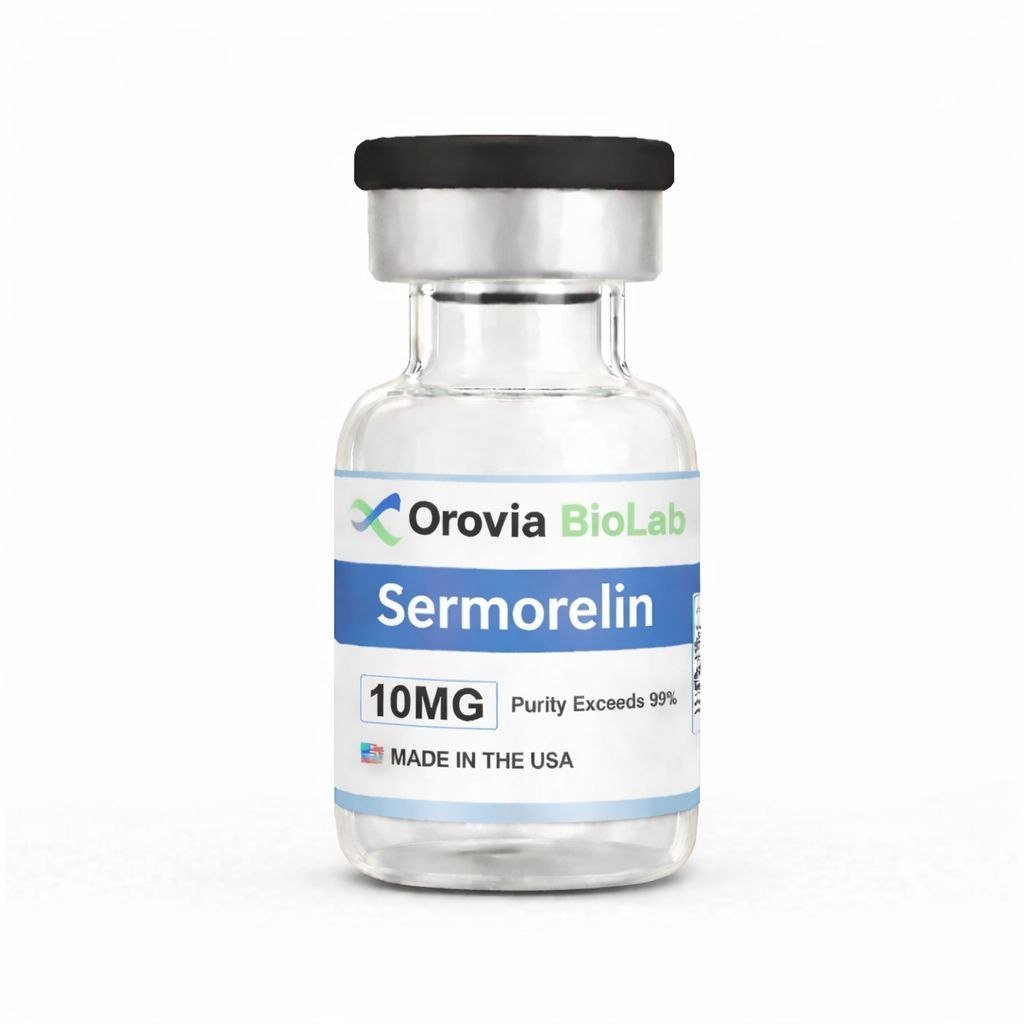
Sermorelin (developmental code GRF 1-29 NH2, chemically designated as $[N\text{-acetyl-L-arginyl}]$-modified truncated human growth hormone-releasing factor or $\text{GRF}_{1-29}\text{-amide}$) is a synthetic polypeptide analogue representing the functional amino-terminal 29-amino acid fragment of endogenous human growth hormone-releasing hormone (GHRH / somatorelin, which naturally spans 44 amino acids). The primary structure corresponds to the sequence:
Amidation of the carboxy-terminal arginine residue stabilizes the peptide against carboxypeptidase degradation while preserving full biological receptor affinity. Sermorelin possesses an empirical molecular formula of $\text{C}_{149}\text{H}_{246}\text{N}_{44}\text{O}_{42}\text{S}$ with a relative molecular weight of approximately $3,357.9\text{ g/mol}$. In clinical and unlicensed settings, sermorelin is presented as sermorelin acetate in sterile, lyophilized single-dose or multi-dose vials (commonly containing $0.5\text{ mg}$, $1\text{ mg}$, $2\text{ mg}$, or $5\text{ mg}$ of active peptide base) intended for reconstitution with bacteriostatic water (0.9% benzyl alcohol) or sterile 0.9% sodium chloride for parenteral (intravenous or subcutaneous) administration.
Within the United Kingdom regulatory framework, sermorelin currently holds no active marketing authorisation (MA) from the Medicines and Healthcare products Regulatory Agency (MHRA). While sermorelin acetate was historically approved under proprietary trade names such as Geref (Serono) as a diagnostic provocative agent to evaluate pituitary growth hormone (GH) secretory capacity and as an orphan therapy for idiopathic growth hormone deficiency (GHD) in children, its therapeutic licenses in the UK and internationally were voluntarily discontinued or withdrawn decades ago, largely displaced by recombinant human growth hormone (somatropin) and alternative neuroendocrine diagnostics. Sermorelin is not scheduled under the Misuse of Drugs Act 1971; however, under the Human Medicines Regulations 2012, prescription-strength peptide products are classified as Prescription Only Medicines (POM). Unregulated multi-dose vials marketed online or through aesthetic/wellness clinics operate in an unlicensed legal grey area, presenting substantial clinical risks regarding non-sterility, inaccurate peptide reconstitution arithmetic, thermal degradation, and synthesis impurities.
The pharmacodynamic profile of sermorelin is mediated by selective binding to the pituitary GHRH receptor, initiating pulsatile somatotroph secretion while maintaining intact systemic neuroendocrine negative feedback:
Pituitary GHRH Receptor (GHRHR) Agonism: Following parenteral injection, sermorelin binds selectively to the high-affinity GHRH receptor, a Class B1 G-protein-coupled receptor (GPCR) predominantly expressed on the cell surface of somatotrophs in the anterior pituitary gland. Receptor activation stimulates the $G_{\alpha s}$ protein subunit, which activates membrane-bound adenylyl cyclase, driving the conversion of ATP to cyclic adenosine monophosphate (cAMP).
Stimulation of GH Synthesis and Secretion: Elevated intracellular cAMP activates protein kinase A (PKA), which phosphorylates voltage-gated L-type calcium channels, causing an influx of extracellular calcium ($Ca^{2+}$). This intracellular calcium surge triggers the immediate exocytosis of pre-formed growth hormone (GH) secretory granules into the capillary sinusoids. Concurrently, the PKA-cAMP-response element-binding protein (CREB) pathway upregulates Pit-1 (POU1F1) transcription factor activity, stimulating de novo growth hormone gene transcription.
Preservation of Somatostatin Sensitivity and Negative Feedback: Unlike exogenous recombinant human growth hormone (somatropin) or autonomous GH-secretagogues, sermorelin does not override pituitary regulatory control. High circulating systemic concentrations of GH and its downstream hepatic mediator, insulin-like growth factor-1 (IGF-1), stimulate hypothalamic periventricular release of somatostatin (growth hormone-inhibiting hormone [GHIH]). Somatostatin binds to somatostatin receptor subtypes 2 and 5 ($SSTR_2$, $SSTR_5$) on somatotrophs, activating the inhibitory $G_{\alpha i}$ pathway, decreasing cAMP, and terminating further GH secretion. Consequently, sermorelin stimulates physiological, pulsatile release rather than constant, supraphysiological continuous exposure, substantially mitigating risks of clinical acromegaly.
Downstream IGF-1 Axis Activation: Systemic pulsatile GH elevations interact with hepatic growth hormone receptors (GHR), activating the Janus kinase 2/signal transducer and activator of transcription 5b (JAK2-STAT5b) pathway. This stimulates the transcription and systemic secretion of IGF-1 and its primary circulating carrier protein, insulin-like growth factor-binding protein-3 (IGFBP-3), promoting peripheral cellular anabolism, chondrocyte proliferation, skeletal mineralization, and lipolysis.
Sermorelin possesses no approved clinical indications in contemporary United Kingdom healthcare. No active pharmaceutical preparations containing sermorelin acetate are currently catalogued in the British National Formulary (BNF) or available for prescription within the NHS.
The National Institute for Health and Care Excellence (NICE) does not endorse, recommend, or integrate sermorelin into any current clinical management pathway. It is absent from modern clinical guidelines governing human growth hormone (somatropin) for growth failure in children (TA188) and human growth hormone deficiency in adults (TA64). Modern endocrinology diagnostics utilize standardized provocative stimuli—principally the Insulin Tolerance Test (ITT), glucagon stimulation test, or macimorelin test—while replacement therapy exclusively utilizes recombinant human growth hormone (somatropin).
Historical, clinical, and unlicensed investigational applications encompass:
Historical Diagnostic Testing (Licensed Geref Protocol): Provocative assessment of pituitary somatotroph functional reserve in paediatric patients with suspected growth retardation. The standardized historical diagnostic dose was a single intravenous bolus of:
$1.0\text{ mcg/kg}$ of body weight (administered intravenously as an acute morning bolus following an overnight fast, with sequential serum GH sampling at 0, 15, 30, 45, and 60 minutes post-injection).
Historical Paediatric Therapeutic Replacement: Off-label daily subcutaneous administration in idiopathic paediatric GHD, historically investigated at:
$30\text{ mcg/kg/day}$ (administered subcutaneously immediately prior to nocturnal sleep).
Unregulated Adult Anti-Ageing and Athletic Wellness Regimens: In unlicensed private wellness, “biohacking,” and sports performance sectors, sermorelin is commercialised off-label as an “anti-ageing” or body composition-modifying agent. Empirical regimens typically utilize:
$100\text{ to }500\text{ mcg}$ una volta al giorno (administered subcutaneously at bedtime, often cycled 5 days on and 2 days off, or co-administered alongside ghrelin-receptor secretagogues such as ipamorelin or GHRP-2).
Sermorelin holds no status within the NHS drug tariff, cannot be prescribed on NHS prescription forms (FP10), and must never replace licensed somatropin in confirmed adult or paediatric growth hormone deficiency.
Because sermorelin is an unesterified, short-chain peptide, its pharmacokinetic disposition is characterized by rapid systemic absorption, extreme biological instability, and rapid intravascular clearance:
Absorption: Following subcutaneous injection, sermorelin is rapidly absorbed from the interstitial subcutaneous compartment into capillaries. Peak plasma concentrations ($C_{max}$) are achieved rapidly, with a median $T_{max}$ ranging between 5 and 20 minutes post-injection. Absolute bioavailability following subcutaneous administration is moderate (approximately $60\text{ to }70\%$) due to local subcutaneous enzymatic degradation. Following direct intravenous bolus administration, peak serum titers are achieved instantaneously.
Distribution: Sermorelin exhibits a relatively small steady-state volume of distribution ($V_{ss} \approx 0.15\text{ to }0.35\text{ L/kg}$), reflecting rapid equilibration within the intravascular and extracellular fluid compartments. Sermorelin exhibits negligible binding to circulating plasma carrier proteins. It does not cross the intact blood-brain barrier in significant amounts; its central endocrine actions occur directly at the fenestrated capillary endothelium of the pituitary gland and median eminence.
Biotransformation: In vivo, sermorelin undergoes rapid proteolytic cleavage. It is cleaved by circulating and membrane-bound neutral endopeptidases (NEP / neprilysin / CD10), dipeptidyl peptidase-4 (DPP-4), and aminopeptidases. The primary cleavage site involves the amino-terminal dipeptide, yielding inactive degradation fragments. It does not rely on the hepatic cytochrome P450 (CYP450) microsomal monooxygenase system.
Elimination: Systemic clearance is rapid. The terminal plasma elimination half-life ($t_{1/2}$) of sermorelin in humans is exceptionally short, estimated between 8 and 12 minutes following intravenous administration (and approximately 15 to 25 minutes following subcutaneous injection due to sustained absorption from the injection site). Metabolites are cleared via glomerular filtration and tubular reabsorption, with degraded native amino acids entering the endogenous amino acid turnover pool. Despite its transient plasma half-life, a single therapeutic injection stimulates downstream endogenous GH release that peaks between 30 and 60 minutes and persists for up to 2 hours.
The primary physiological effect reported in clinical investigations is a transient, physiological pulse of endogenous growth hormone followed by a gradual, modest elevation in circulating serum IGF-1 and IGFBP-3 concentrations. This pathway stimulates lipolysis, promotes lean skeletal muscle nitrogen retention, and supports chondrocyte and osteoblast activity without the sustained supraphysiological GH spikes associated with exogenous somatropin. However, administration produces a distinct spectrum of acute adverse effects:
Very Common ($\ge 1/10$):
Transient facial flushing (rubor) and subjective sensations of warmth, occurring within 2 to 15 minutes post-injection in up to $20\%$ of recipients (secondary to transient peripheral cutaneous vasodilation).
Injection-site reactions: localized erythema, swelling, pruritus, induration, and discomfort at the subcutaneous injection site.
Common ($1/100$ to $<1/10$):
Cephalalgia (headache); transient nausea; dizziness and lightheadedness; metallic or altered taste sensations (dysgeusia); transient fatigue or somnolence.
Uncommon ($1/1,000$ to $<1/100$):
Transient peripheral fluid retention: mild peripheral oedema (fingers, ankles), subjective joint stiffness, or mild arthralgia (secondary to GH-induced sodium retention via the renin-angiotensin-aldosterone axis).
Sleep architecture disruption or vivid dreams.
Development of anti-sermorelin antibodies: neutralizing or non-neutralizing anti-GHRH antibodies develop in up to $15\text{ to }20\%$ of patients receiving continuous daily therapy lasting greater than 6 months, which can attenuate clinical efficacy.
Rare ($1/10,000$ to $<1/1,000$):
Type I immediate allergic hypersensitivity reactions (generalized urticaria, periorbital angioedema, bronchospasm, or anaphylactoid collapse), primarily provoked by reconstituted impurities or sensitivity to benzyl alcohol preservatives.
Carpal tunnel syndrome (induced by acute synovial fluid expansion within the flexor retinaculum).
Clinical and Diagnostic Hazards: Sourcing unregulated sermorelin vials from online grey-market distributors carries substantial risks of compounding non-sterility, resulting in localized subcutaneous abscesses, cellulitis, or systemic pyrogenic reactions. Furthermore, using unlicensed GH secretagogues to manage severe unremitting lethargy, sarcopenia, or metabolic failure presents a critical diagnostic hazard by delaying medical evaluation for underlying pituitary neoplasms, adult hypopituitarism, or occult malignancies.
The handling and administration of sermorelin require strict adherence to endocrinological contraindications and pharmacological precautions:
Contraindications:
Active Malignancy: Absolute contraindication in patients with active intracranial or systemic neoplasms, active malignant progression, or proliferative diabetic retinopathy. The GH/IGF-1 axis exerts potent mitogenic, anti-apoptotic, and angiogenic signaling; stimulating this pathway can accelerate tumour proliferation.
Known Pituitary Non-Function / Pituitary Apoplexy: Absolute contraindication for therapeutic use in panhypopituitarism caused by complete surgical hypophysectomy, pituitary stalk transection, or total destructive irradiation, where absence of somatotrophs renders GHRH analogues ineffective.
Documented Hypersensitivity: Absolute contraindication in individuals with confirmed hypersensitivity to sermorelin acetate, mannitol, or benzyl alcohol (preservative).
Pregnancy and Lactation: Absolute contraindication. Sermorelin crosses into fetal circulation in animal models; developmental safety, embryotoxicity, and teratogenicity profiles in humans remain uncharacterized.
Closed Epiphyses (in Paediatric Diagnostic Contexts): Inappropriate for linear growth stimulation once epiphyseal fusion has completed.
Drug Interactions:
Exogenous Corticosteroids (e.g., Prednisolone, Hydrocortisone, Dexamethasone): Concomitant supraphysiological glucocorticoid administration suppresses pituitary somatotroph responsiveness to GHRH analogues, attenuating sermorelin-induced GH release.
Muscarinic Cholinergic Agonists and Antagonists: Muscarinic antagonists (e.g., atropine, pirenzepine) blunt GH release in response to sermorelin by enhancing endogenous somatostatin tone. Conversely, acetylcholinesterase inhibitors (e.g., pyridostigmine) enhance somatotroph responsiveness by suppressing hypothalamic somatostatin release.
Somatostatin Analogues (e.g., Octreotide, Lanreotide): Direct functional antagonism; somatostatin analogues completely suppress pituitary responsiveness to GHRH.
Exogenous Thyroid Hormones: Untreated primary hypothyroidism blunts the pituitary GH secretory response to sermorelin; euthyroid status must be established prior to clinical evaluation.
Insulin and Oral Antidiabetic Drugs: Elevations in circulating GH can transiently induce peripheral insulin resistance; individuals with impaired glucose tolerance require blood glucose monitoring.
Clinical Precautions and Harm Minimisation:
Endocrine Alarm Symptoms (“Red Flags”): Patients presenting with visual field deficits (specifically bitemporal hemianopia, indicative of optic chiasm compression by a pituitary adenoma), severe intractable morning headaches, galactorrhoea, or acute polyuria/polydipsia mandate urgent NHS endocrine and neurosurgical evaluation rather than self-directed peptide administration.
Clinical Monitoring Protocols: Individuals using GHRH analogues in specialist research or clinical environments require structured monitoring: baseline and regular serum IGF-1 titers (which must not be sustained above the age-adjusted upper limit of normal [$+2\text{ SDS}$]), fasting plasma glucose, glycated haemoglobin ($HbA1c$), thyroid function panels (TSH, free $T_4$), and dermatological surveillance of melanocytic naevi.
Reconstitution and Cold-Chain Integrity: Because sermorelin degrades rapidly via hydrolysis and deamidation, lyophilized cakes must be stored under refrigeration ($2\text{ to }8^\circ\text{C}$) protected from light; once reconstituted with bacteriostatic water, vials must be maintained refrigerated and discarded within 28 days.
| Quantità | 5mg, 10mg |
|---|

 English English
  German
 Italian
 Dutch
Dutch
 Spanish

Recensioni
Ancora non ci sono recensioni.