- Uw winkelwagen is leeg
- Verder Winkelen


£ 148.00
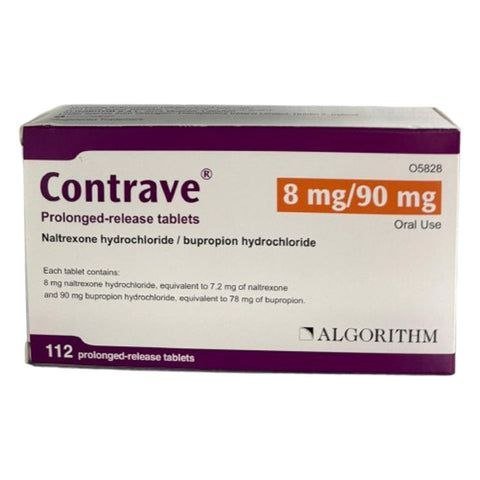
Contrave (naltrexone hydrochloride 8 mg / bupropion hydrochloride 90 mg) is a fixed-dose combination extended-release tablet indicated as an adjunct to a reduced-calorie diet and increased physical activity for chronic weight management in adults with obesity or overweight.
Contrave is an orally administered fixed-dose dual-agent combination tablet containing two active pharmaceutical ingredients:
Naltrexone Hydrochloride (8 mg): An opioid receptor antagonist chemically designated as 17-(cyclopropylmethyl)-4,5$\alpha$-epoxy-3,14-dihydroxymorphinan-6-one hydrochloride.
Bupropion Hydrochloride (90 mg): An aminoketone antidepressant chemically designated as -1-(3-chlorophenyl)-2-[(1,1-dimethylethyl)amino]-1-propanone hydrochloride.
Under the Anatomical Therapeutic Chemical (ATC) system, this combination is classified under A08AA62 (anti-obesity preparations, centrally acting). It is regulated internationally as a Prescription Only Medicine (POM).
Contrave acts centrally within two key regions of the central nervous system: the arcuate nucleus of the hypothalamus and the mesolimbic dopamine circuit (reward pathway).
Hypothalamic Appetite Regulation: Bupropion stimulates pro-opiomelanocortin (POMC) neurons in the arcuate nucleus to release -melanocyte-stimulating hormone (-MSH), which activates MC4 receptors to promote satiety and decrease food intake.
Opioid-Mediated Feedback Inhibition: Under baseline conditions, POMC stimulation concurrently releases endogenous opioids (-endorphin), which bind to -opioid receptors on POMC neurons to exert autoinhibitory negative feedback. Naltrexone blocks these -opioid receptors, preventing feedback inhibition and sustaining bupropion-induced firing of POMC neurons.
Reward Circuit Modulation: Synergistic activity across the mesolimbic dopamine pathway reduces food cravings and hedonic reward responses associated with eating.
Licensing for Contrave includes:
Chronic Weight Management: Adjunct to a reduced-calorie diet and increased physical activity for chronic weight management in adults with:
Initial Body Mass Index (BMI) of (obesity), or
Initial BMI of to (overweight) in the presence of at least one weight-related comorbidity (e.g., controlled hypertension, type 2 diabetes mellitus, or dyslipidemia).
Dosing & Administration Regimen:
Stepwise Escalation Schedule: To improve gastrointestinal tolerance, dosage must be titrated weekly over 4 weeks to the target maintenance dose of 2 tablets twice daily (total daily dose: 32 mg naltrexone / 360 mg bupropion):
Week 1: 1 tablet in the morning.
Week 2: 1 tablet in the morning, 1 tablet in the evening.
Week 3: 2 tablets in the morning, 1 tablet in the evening.
Week 4 onwards (Maintenance): 2 tablets in the morning, 2 tablets in the evening.
Administration Rules: Swallow tablets whole; do niet cut, chew, or crush. Do not take with high-fat meals, as high fat content significantly increases systemic exposure to both drugs.
Absorption: Both components are absorbed following oral administration. Peak plasma concentration () occurs at approximately 2 hours for bupropion and 3 hours for naltrexone.
Distribution: Protein binding is 21% for naltrexone and 84% for bupropion.
Biotransformation:
Bupropion: Extensively metabolized in the liver via CYP2B6 to active metabolites (hydroxybupropion, threohydrobupropion, and erythrohydrobupropion).
Naltrexone: Metabolized in the liver primarily via dihydrodiol dehydrogenase to its major active metabolite, 6$\beta$-naltrexol.
Elimination: Excreted predominantly in urine as metabolites. Elimination half-lives () for bupropion and naltrexone are approximately 21 hours and 5 hours (13 hours for 6$\beta$-naltrexol), respectively.
Contrave impacts central neurochemical signaling, blood pressure, heart rate, and gastrointestinal motility.
Very Common (): Nausea, constipation, vomiting, headache, insomnia, dry mouth, dizziness.
Common ( to ): Diarrhea, abdominal pain, anxiety, agitation, hot flashes, hyperhidrosis, dysgeusia, tremor, tinnitus, palpitations, increased blood pressure, heart rate elevation.
Uncommon ( to ): Confusional state, hallucinations, depression, suicidal ideation, visual impairment, alopecia, acute cholecystitis.
Rare (<1/1,000): Seizures, serotonin syndrome, severe hepatic dysfunction, anaphylactic reactions.
Uncontrolled hypertension.
Seizure disorders or history of seizures.
Current or prior diagnosis of bulimia or anorexia nervosa (due to heightened seizure risk).
Chronic opioid therapy, acute opioid withdrawal, or failed opioid challenge.
Concomitant use of monoamine oxidase inhibitors (MAOIs) or within 14 days of stopping MAOIs.
Abrupt withdrawal of alcohol, benzodiazepines, barbiturates, or antiepileptic drugs.
Opioids: Naltrexone blocks the therapeutic effects of opioid analgesics; administration to opioid-dependent individuals precipitates acute opioid withdrawal.
CYP2B6 Inhibitors/Inducers: Strong CYP2B6 inhibitors (e.g., ticlopidine, clopidogrel) increase bupropion exposure; do not exceed 1 tablet twice daily. CYP2B6 inducers (e.g., ritonavir, carbamazepine) decrease bupropion exposure and efficacy.
Drugs Metabolized by CYP2D6: Bupropion inhibits CYP2D6, increasing plasma levels of co-administered drugs cleared via this pathway (e.g., certain antidepressants, antipsychotics, -blockers, and Type 1C antiarrhythmics).
Boxed Warning (Suicidality & Neuropsychiatric Reactions): Bupropion is an antidepressant component; monitor patients for emergence of suicidal thoughts, depression, mania, or unusual changes in mood or behavior, particularly in adolescents and young adults.
Seizure Risk: Bupropion can cause dose-related seizures. Do not exceed maximum recommended total daily dose of 4 tablets (32 mg/360 mg).
Blood Pressure & Pulse: Can increase systolic and diastolic blood pressure and resting heart rate. Monitor blood pressure and pulse prior to initiating treatment and regularly throughout therapy.
 English English
  German
 Italian
 Dutch
Dutch
 Spanish